
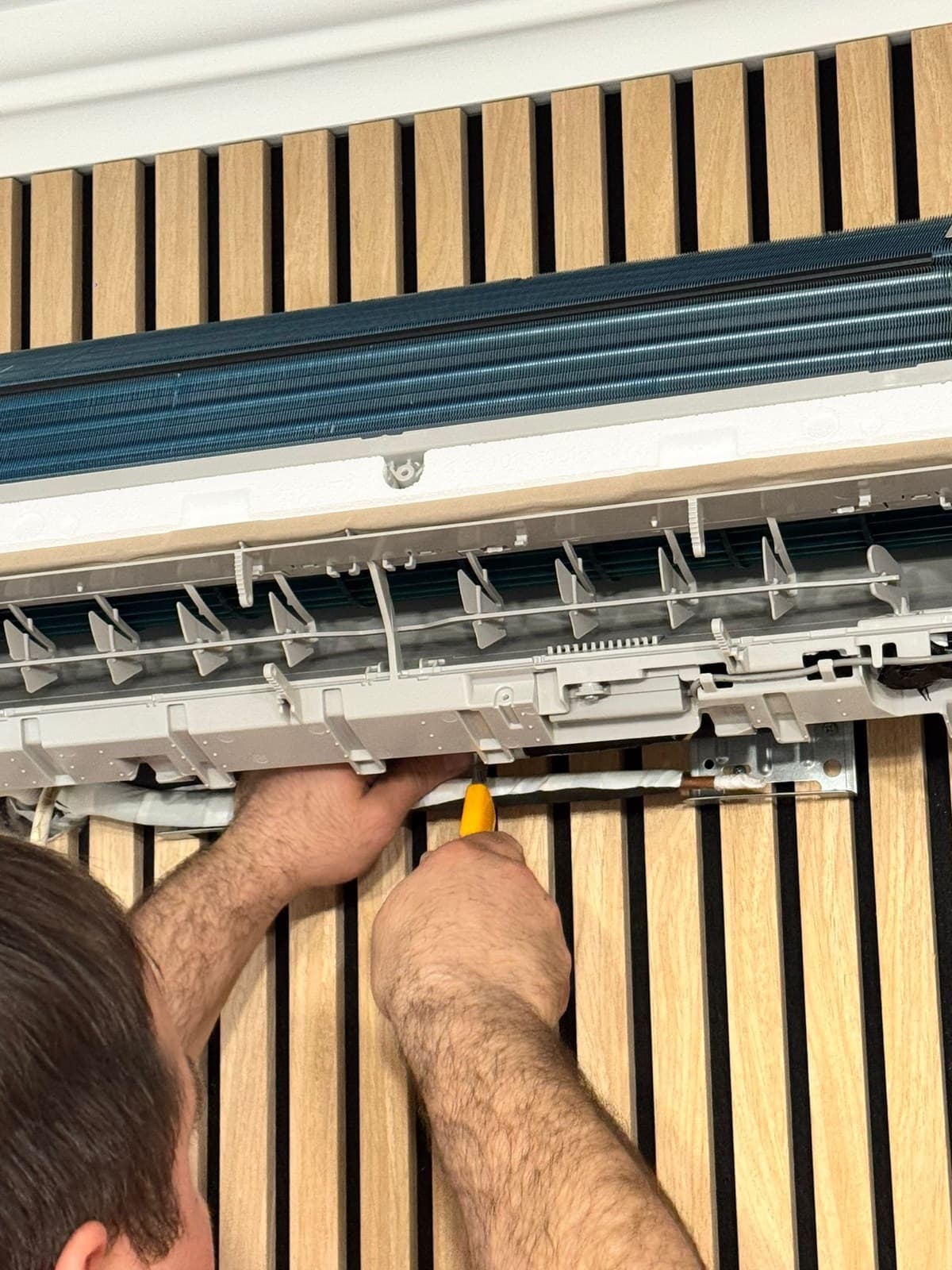
There is no “silent” air conditioner — there are quiet ones. The difference between 19 and 26 dB on the indoor unit is the difference between a ticking clock and a whisper, and it decides whether you sleep with the AC on in a panel-block bedroom. Here is what the Quiet, Sleep and night modes actually do, which models are quiet on paper, and what to do when your unit has become louder than it used to be.
What the decibels on the label mean
Manufacturers quote indoor noise at the lowest fan speed — that is the 19–22 dB figure in the brochure. At medium speed the same unit is 30–35 dB, at high 40–45 dB. For reference: 20 dB is a quiet room at night, 30 dB a whisper at one metre, 40 dB a quiet conversation.
The outdoor unit is 45–55 dB and that is what the neighbours hear. Mounted 1.5 m from a neighbour’s bedroom through a thin wall, vibration travels through the structure — that is what anti-vibration pads are for, and we fit them as standard.
Quiet / Silent mode — the lowest fan speed
The QUIET button (Gree, AUX, Toshiba) or SILENT (Daikin, Mitsubishi) fixes the fan at minimum and on most brands also limits the outdoor unit’s speed. Result: 19–22 dB inside, quieter outside too, but slower to reach temperature. Use it after the room is cooled or heated, not from the start.
Sleep / night mode — not the same thing
SLEEP does three things: lowers the fan, switches off the display and adjusts the set point by 1 °C every hour (up when cooling, down when heating) — 2 °C in total over the first two hours, then holds. The idea: a sleeping body needs less cooling, and the unit runs at lower output and more quietly. After 7–8 hours most models switch off by themselves.
Gree calls it SLEEP with four variants (Sleep 1–4) on newer models; Daikin NIGHT SET; Mitsubishi Heavy NIGHT SETBACK; Toshiba Comfort Sleep. Same function.
Which models are genuinely quiet (rated, lowest speed)
- Mitsubishi Heavy SRK ZS / ZSX — 19 dB, our most common bedroom pick.
- Gree Soyal II / Amber — 19–20 dB.
- Toshiba Super Daiseikai / Shorai Edge — 19–20 dB.
- Daikin Stylish / Perfera — 19 dB.
- Hitachi AirHome 400 — 20 dB.
- Mid range (Gree Airy, LG Standard, Toshiba Yukai) — 21–23 dB: perfectly fine for a bedroom in Sleep mode.
- Budget (AUX, Nippon, Techpoint) — 24–27 dB: fine for a living room or office; for a light sleeper’s bedroom — rather not.
The AC got louder — 6 causes by frequency
- Dirty filters and fan wheel. Dust on the blades unbalances it — humming and whistling appear. Filters are washed at home; the fan wheel is cleaned at maintenance.
- Cracking and clicking on start and stop. The plastic casing expands with temperature. Normal if brief.
- Gurgling. Refrigerant or condensate in the drain. Normal when heating; if constant in summer, the drain is blocked.
- Outdoor unit vibration. Loose bracket bolts or worn pads. Fixed in 20 minutes on site.
- Rattling louvres. A broken tooth on the louvre motor — a small part, replaced.
- Compressor whine. The only serious one of the six — refrigerant shortage or wear. Diagnostics, not waiting.
How to reduce noise without a service call
- Wash the filters every 2–4 weeks in season — 5 minutes under the shower.
- Use Quiet after reaching temperature, not Low all the time.
- Do not set 18 °C in summer — the unit runs flat out and is loud. 24–26 °C + Dry gives the same comfort.
- Check that the outdoor unit does not touch a railing or wall.
- At installation ask for the indoor unit on the side wall, not above the headboard — noise and airflow stay away from your head.
If you are choosing a new AC for a bedroom
Look for three numbers: noise ≤ 21 dB, SEER ≥ 7 (quiet mode should not also be inefficient) and minimum output below 1 kW — the inverter’s ability to run “quietly” without stopping and starting. All three are in the specs of every product card, and the dB comparison is in the table on every brand page.