
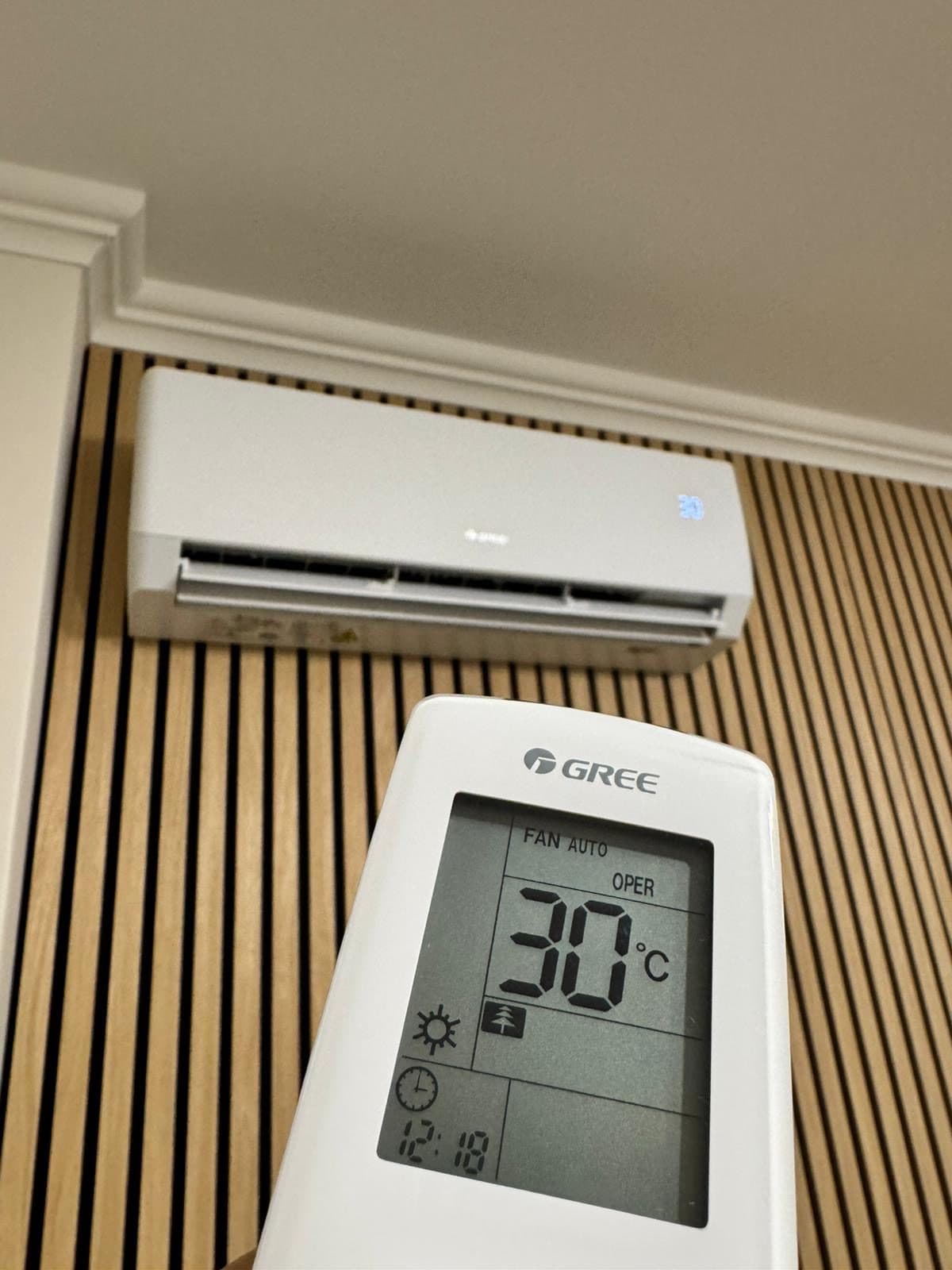
Every autumn we get the same calls: “I switched the AC to heating and it blows cold”, “I set 30 degrees and the room won’t warm up”, “The outdoor unit is steaming — is it broken?”. Nine times out of ten the unit is fine — it is just set wrong. Here is how to do it properly, step by step, and what the scary-looking things actually mean.
1. Heat mode — and how to spot it on any remote
The MODE button cycles Auto → Cool → Dry → Fan → Heat. Look for the sun icon (Gree, AUX, Nippon, Toshiba) or the word HEAT(Daikin, Mitsubishi). If the display shows a snowflake you are in Cool and the unit will cool no matter what temperature you set.
Auto is not “smart” — it switches between heating and cooling around the set point and in the shoulder months can cool at 7 a.m. For winter, select Heat explicitly.
2. What temperature to set
21–23 °C. Not 28, not 30. An inverter does not work “harder” at a higher setting — it runs longer at full output to get there, and every degree above 22 °C costs about 5–7 % more electricity. If you feel cold at 22 °C the problem is airflow direction or unit capacity, not the number.
For the first 5–10 minutes after switching to Heat the unit deliberately does not blow — it waits for the heat exchanger to warm up so it does not blast you with cold air. Gree and AUX show a “pre-heating” indicator during this time. Not a fault.
3. Airflow direction: down, not forward
Warm air rises. With the louvres horizontal (the summer position) the heat stays under the ceiling while it is 17 °C at floor level. Point the vertical louvres fully down — press SWING and stop at the lowest position, or select “down” directly on Daikin/Mitsubishi. It feels like a two- or three-degree difference.
4. Fan speed
In winter leave it on Auto. The unit pushes more air while the room is cold and slows down once it reaches temperature. Forcing Low / Quiet in a cold room is a mistake — the heat exchanger overheats, the compressor stops on protection and the room never warms up.
5. The outdoor unit “steams” and drips — that is normal
When heating, the outdoor unit runs below freezing and frost builds on it. Every 40–60 minutes the unit stops heating for 3–5 minutes, the indoor fan goes quiet and the outdoor unit releases steam — that is the defrost cycle. The water under the outdoor unit in winter comes from exactly this. Not a fault, do not touch anything.
If the outdoor unit sits above a pavement or a neighbour’s balcony, fit a drain plug and hose for the condensate so ice does not form. We do it at installation if you tell us in advance.
6. “The AC won’t heat” — 5 checks before calling service
- Mode is Heat (sun), not Cool or Dry. The most common cause.
- Set temperature is above room temperature. If the room is 22 °C and you set 22, the unit simply waits.
- It is not in defrost. Wait 10 minutes.
- Filters are clean. Clogged filter = weak airflow = room does not warm. Rinse with water.
- The outdoor unit is not blocked. Snow, leaves or boxes in front of it stop the heat exchange.
If it still blows lukewarm at -5 °C outside, the unit may have reached its limit. Entry models are rated to -7…-10 °C; for primary heating in Varna pick a model rated to -15 °C with SCOP above 4.
7. Settings that save electricity in winter
- Do not switch off when leaving for 2–3 hours. Drop to 18–19 °C. Reheating a cold room costs more than holding it.
- At night — 19–20 °C and Sleep mode, which gently lowers temperature and noise overnight.
- Timer: start 30 minutes before you get up instead of full power at 6 a.m. when it is coldest outside.
- Close the doors of the room the unit is in. One 12,000 BTU unit heats one room, not an apartment.
Brand specifics
Gree: the Heat icon is a sun; I FEEL measures temperature at the remote, not the unit — use it if you sit far from the AC. Daikin: POWERFUL gives 20 minutes of full output for fast warm-up. Mitsubishi Heavy: HI POWER does the same; ECONOcaps output to save. Toshiba: Hi POWER and Comfort Sleep. AUX: Turbo and 8 °C Heating — holds the room at 8 °C so it does not freeze while you are away for days.
When you really need service
If the unit shows an error code (E1, H6, F0 etc.), if the outdoor unit does not start at all, or if the heat exchanger ices up and does not defrost — call us. Diagnostics is €20 and is waived if we do the repair. Annual maintenance before the season prevents most of these cases.