
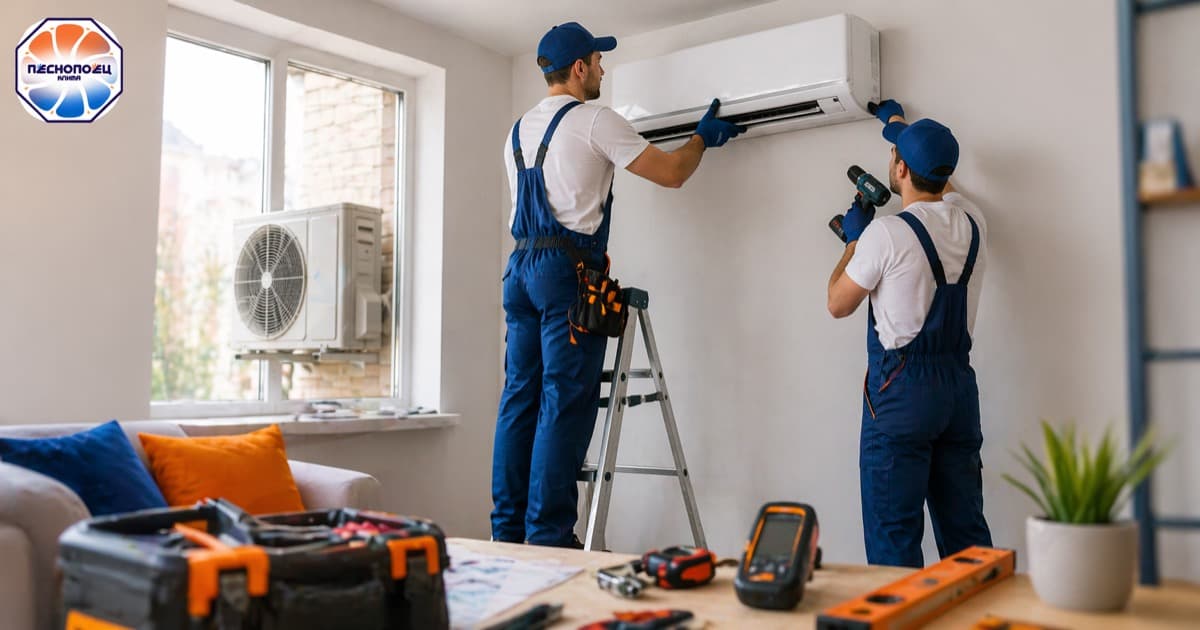
What "standard installation" actually means
Every company advertises a price for "standard installation," but few people know what that actually includes. Here is the full list of components and work you should receive:
- Indoor unit bracket — a metal plate mounted on the wall. The indoor unit clicks onto it. Must be perfectly level, otherwise condensate does not flow properly toward the drain.
- Outdoor unit bracket/console — usually L-shaped metal brackets bolted to the facade. Must support the unit weight plus vibration during operation.
- Copper pipe (3 meters) — two copper pipes (liquid and gas lines) of different diameters, carrying refrigerant between units. The standard price includes 3 meters. Most apartments actually need 4-6 meters.
- Insulation — every copper pipe is wrapped with thermal insulation along its full length. Without it, you lose efficiency and risk condensation forming on the pipes.
- Drain pipe — carries condensate (water) from the indoor unit outside. Must have a downward slope for gravity drainage.
- Electrical cable — connects the indoor and outdoor units. The power cable to the outlet is usually included, but if you need a new circuit from the breaker panel, that is separate.
- Wall penetration (1 hole) — approximately 65 mm diameter, through which pipes, drain, and cable pass. One hole is included in the standard price.
The 3-meter pipe rule
Three meters of copper pipe sounds like enough, but in practice it rarely is. The indoor unit sits on the wall, the outdoor unit on the facade or balcony. Between them you have wall thickness (30-50 cm in panel buildings), vertical distance, and bends. In a typical Varna apartment, you actually need 4-5 meters, and if the outdoor unit is on a different wall, even more. Always ask in advance how much pipe will be needed and the price per extra meter.
Vacuum evacuation — why it is mandatory
After connecting the pipes, the system must be vacuumed using a vacuum pump. This removes moisture and air from the lines. If moisture remains, it reacts with refrigerant and forms acids that corrode the compressor from inside. If air remains, pressure is wrong and efficiency drops.
Vacuuming should last at least 15-20 minutes. If the technician simply "releases the gas" without a vacuum pump, that is not a proper installation. The "purge" method (releasing a bit of refrigerant to push out air) is outdated and harmful to the system.
Commissioning
After vacuuming comes the final check: leak test (no refrigerant escaping), pressure measurement, starting the unit, and measuring the outgoing air temperature. The difference between intake and output should be 8-12°C. If everything checks out, the installation is complete.
Installation prices in Varna (2026)
Current prices for standard installation. Prices include 3 m copper pipe, all fittings, insulation, drain, vacuum evacuation, and commissioning.
| Capacity | Base price |
|---|---|
| Up to 14,000 BTU (small room) | 372 BGN |
| Up to 24,000 BTU (living room) | 450 BGN |
Extra costs that may apply
| Service | Price |
|---|---|
| Extra copper pipe (per meter) | 60-80 BGN/m |
| Additional wall drilling | 40 BGN |
| Wall chasing (hiding pipes in the wall) | 15 BGN/m |
| Old unit removal | 80 BGN |
| Crane access (high floors) | by quote |
| Electrical work (new circuit) | by quote |
Hidden costs nobody tells you about
The most common question after installation: "Why is the final bill higher than the advertised price?" Here is where the extras hide:
Copper pipe extension. Most real installations need 4-6 meters, not 3. That means 60-240 BGN extra. It is not a scam — 3 meters covers the ideal case, but real distances are longer.
Electrical circuit. If your AC is 18,000+ BTU, it likely needs its own circuit with a 16A breaker. If your apartment does not have one prepared, you will need an electrician — a separate cost.
Building permission. Some Varna apartment buildings (especially newer ones) require written approval from the homeowners association (HOA) for outdoor unit placement on the facade. Check before installation to avoid problems later.
Condensate pump. If the drain pipe cannot be routed with a natural slope (for example, when mounting on an interior wall), you need a condensate pump. Cost: 100-150 BGN for the pump plus installation.
Concrete walls in panel buildings. Drilling through reinforced concrete is slower and harder than brick. Some companies charge extra for concrete, others do not. Ask in advance.
Summer rush. May through August is peak installation season. Some companies do not officially charge more, but wait times are longer. If you can, schedule for April or September.
Our approach: we do a site survey or clarify details by phone and give you a fixed price BEFORE starting work. No surprises on the final bill.
Varna-specific installation considerations
Varna is not Sofia. The climate and building stock require a different approach to installation.
Panel buildings.A large portion of Varna's housing stock consists of concrete panel buildings from the 1970s-80s. Walls are reinforced concrete — drilling is slower and requires more powerful tools. Pipe runs are longer because interior walls are thick.
Sea proximity. If you live in a coastal neighborhood, the outdoor unit is exposed to salt air. Standard brackets rust faster. We recommend stainless or galvanized brackets and anti-corrosion coating on the housing.
Balcony placement.The most common setup in Varna apartments. The balcony provides easy access for future maintenance and protects from direct sun. But check your building's HOA rules — some have restrictions.
Wind load. Varna is a windy city, especially in coastal areas. The outdoor unit must be securely mounted because wind vibration stresses the brackets and can cause noise.
Salt spray zone (Chayka, Vinitsa, Galata, Asparuhovo). Corrosion is most aggressive here. Beyond anti-corrosion brackets, we recommend periodic maintenance of the outdoor unit — washing the condenser at least twice a year.
How to spot quality vs bad installation
Signs of good installation
- Vacuum pump used — you should hear it running for 15-20 minutes. If the technician never took one out, that is a problem.
- Full-length pipe insulation — from indoor to outdoor unit, no bare sections.
- Tidy cable management — cables secured with zip ties, not hanging loose.
- Drain tested — the technician pours water into the indoor unit tray to verify it flows properly outside.
- Temperature measured — after starting, the intake/output difference is checked (8-12°C).
Signs of bad installation
- No vacuum— the technician just "releases the gas." The most common and most damaging mistake.
- Bare copper pipes — no insulation or partial insulation. You lose efficiency and risk condensation.
- Messy cables — hanging wires and uninsulated connections mean careless work.
- Drain not tested — if unchecked, water may drip down your wall within a week.
- Rushed job — a single split installation in under 1 hour is suspiciously fast. Normal time is 2-4 hours.
Consequences of bad installation
Noise and vibration from a poorly mounted outdoor unit. Refrigerant leaks from bad connections — the AC stops cooling/heating within months. Water stains on walls from improper drainage. And worst of all — voided manufacturer warranty. Many people do not realize that bad installation costs them their warranty coverage.
Post-installation checklist — what to verify
Before the technician leaves, check these items. Takes 10 minutes but can save you thousands:
- Temperature difference between intake and output is 8-12°C
- No water dripping from any connection
- Outdoor unit is level and securely mounted
- Remote control works, all modes tested (cooling, heating, fan)
- Drain line drains freely
- Installer explained basic operation
- You have the warranty card and installation invoice
- Take a photo of the installation for your records
Warranty and installation — the connection most people miss
This may be the most important part. The manufacturer warranty (typically 3-5 years for the compressor) is NOT unconditional. It requires installation by a qualified technician, with proper vacuum evacuation and according to manufacturer specifications.
If you hired someone "off the books" and cannot show an installation invoice from a registered company, the manufacturer may refuse warranty repairs. We have seen cases where people paid 800+ BGN for a compressor that should have been replaced free under warranty.
Our installation: comes with 12-month workmanship warranty and preserves the full manufacturer warranty. We issue an invoice and warranty card.
Tip: keep the installation invoice in a safe place. You will need it for warranty claims. Also take a photo of it on your phone, just in case.
Related services in Varna
- AC installation — fixed prices, 12-month warranty, same-day service available.
- Maintenance and cleaning — annual service from €36, extends AC lifetime by years.